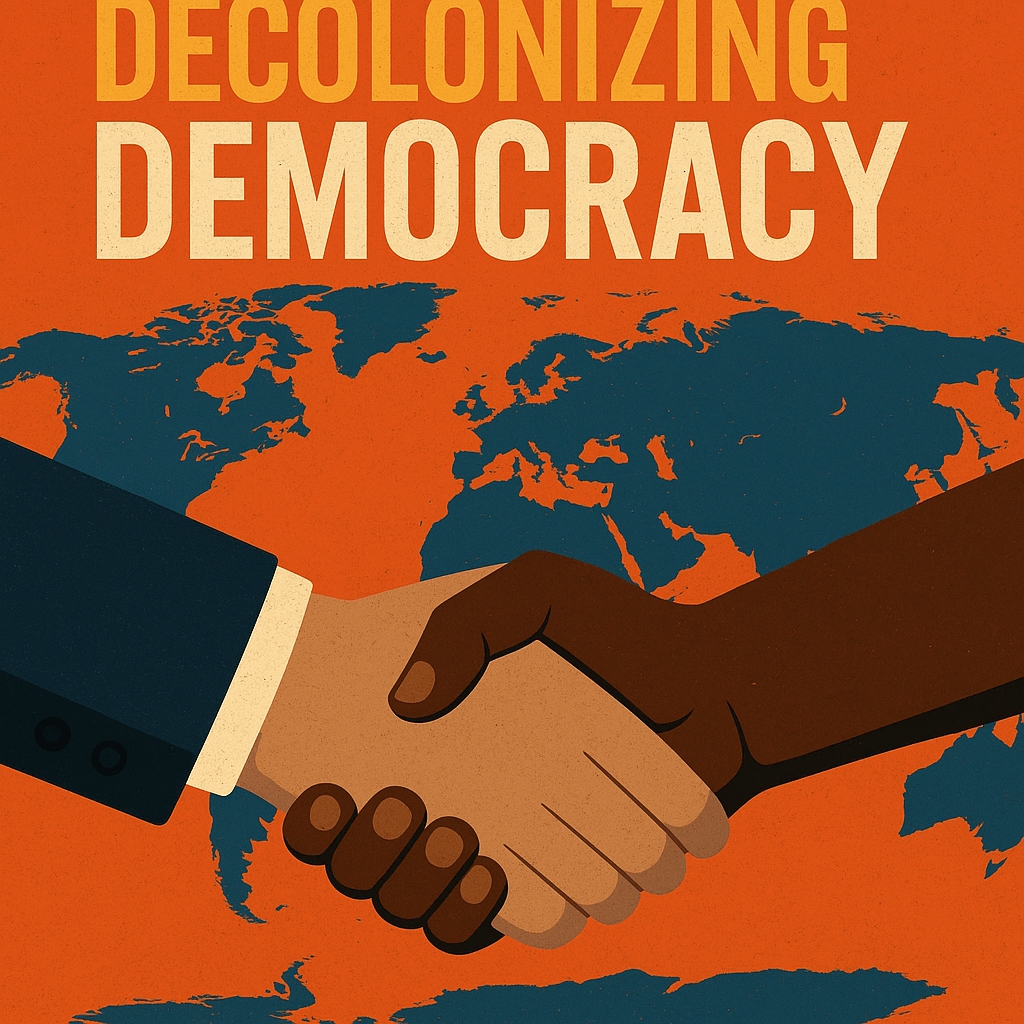
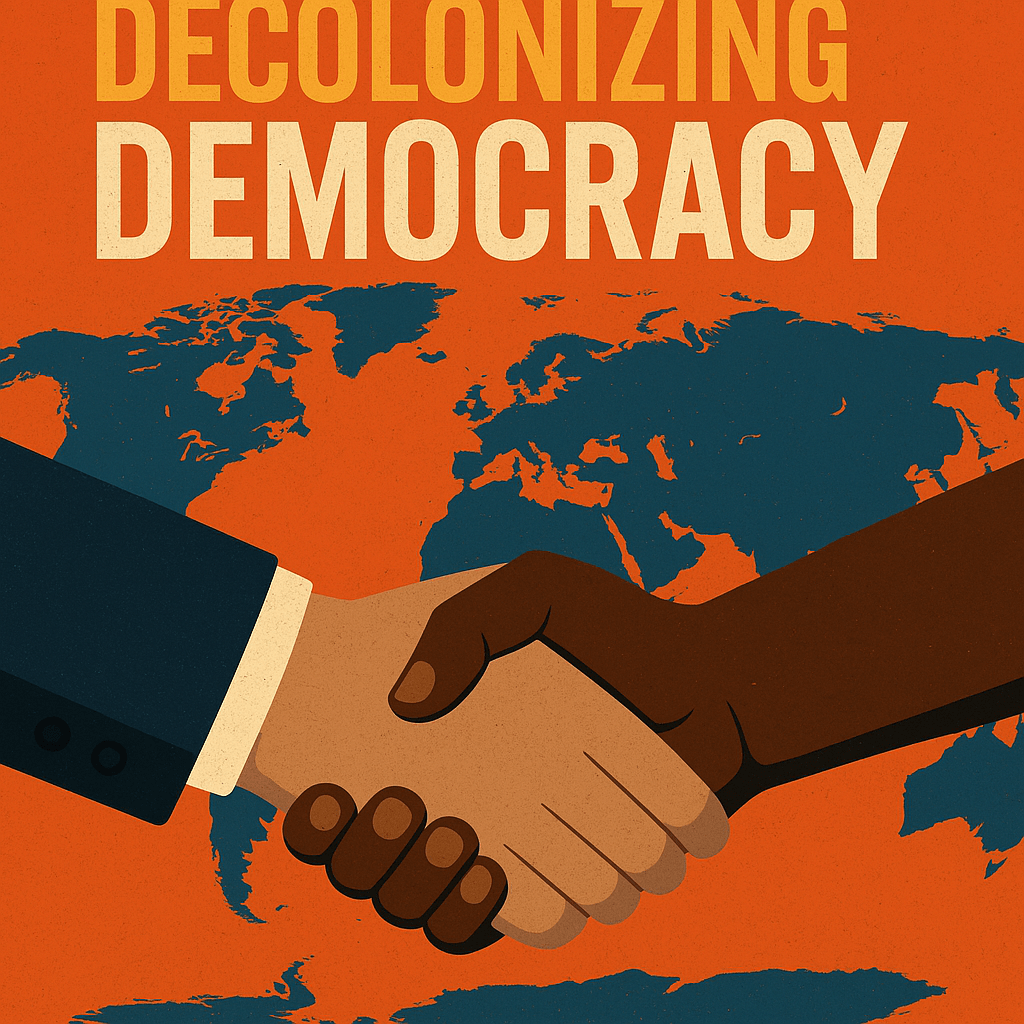
For centuries, democracy, freedom, and equality have been framed as universal ideals, yet their definitions have largely been shaped by a Western lens. The modern nation-state system, electoral democracy, and human rights discourse have their roots in European and American political traditions—often imposed through colonial expansion. Today, as Western democracies grapple with political dysfunction, rising authoritarianism, and internal fractures, it is time to question whether their model of governance was ever truly universal or simply one interpretation among many.
Decolonizing our understanding of democracy means moving beyond the assumption that the Western model is the only—or even the best—way to ensure liberty and justice. Instead, it requires recognizing diverse governance traditions from around the world, many of which have been erased or marginalized by colonial narratives. As governments worldwide face new challenges, including economic instability, digital misinformation, and the resurgence of expansionist politics, these alternative models could offer valuable lessons for the future.
The Western Crisis: A System in Decline
The cracks in Western democracies are becoming increasingly visible. Electoral systems once held up as the gold standard are now riddled with dysfunction. In the United States, allegations of voter suppression and gerrymandering have undermined trust in the democratic process, while the influence of corporate money in politics has left many disillusioned with a system that often prioritizes business interests over public welfare. In the United Kingdom, political instability following Brexit has exposed how party-driven governance can lead to national uncertainty rather than long-term planning.
At the same time, economic inequality continues to widen. Neoliberal policies, once touted as the key to prosperity, have instead deepened the gap between the wealthy elite and the working class. The idea that democracy naturally leads to economic fairness is being challenged as wages stagnate, housing becomes increasingly unaffordable, and public services are eroded. This has fueled populist movements across the Western world, leading to the rise of leaders who challenge democratic norms while claiming to protect the interests of the people.
For those who have long associated democracy with freedom and progress, these shifts are unsettling. But they also raise a critical question: Was the Western model of governance ever meant to work for everyone? And if not, what alternative systems have been lost to history that might offer better solutions?
Beyond the Western Framework: Lessons from Other Traditions
Long before European colonialism, many societies across Africa, Asia, and the Americas had developed governance systems that functioned effectively for their communities. These systems, often dismissed as “pre-modern” by colonial rulers, offer important insights into how societies can be governed in more inclusive and sustainable ways.
In parts of Africa, consensus-based governance was the norm. The Gadaa system, practiced by the Oromo people of Ethiopia, is an indigenous democratic socio-political system that regulates political, economic, social, and religious activities. It serves as a mechanism for enforcing moral conduct, building social cohesion, and expressing forms of community culture. Leaders are elected and hold office for eight years before power is transferred to the next group, ensuring accountability and collective decision-making. Source: UNESCO
In North America, the Haudenosaunee Confederacy, also known as the Iroquois Confederacy, is one of the oldest participatory governance systems in the world. Founded on the Great Law of Peace, it established a council of 50 chiefs representing different clans and nations, with decisions made through consensus to ensure unity and collective well-being. This model stood in contrast to the often short-term focus of Western political systems, where policy decisions are driven by election cycles rather than long-term societal needs. Source: Haudenosaunee Confederacy
In East Asia, governance models have historically emphasized meritocracy over populism. Confucian political philosophy, which influenced governance in China, Korea, and Japan, prioritized leadership based on education, ethical responsibility, and competency.
In modern Singapore, elements of this philosophy have been integrated into a hybrid system that combines democratic elections with a strong emphasis on technocratic leadership. While criticized for its restrictions on political opposition, Singapore’s model has delivered stable governance and long-term economic planning—raising the question of whether electoral democracy alone is always the best measure of good governance.
Meanwhile, in Southern Africa, the philosophy of Ubuntu—“I am because we are”—offers a radically different approach to governance. Unlike Western democracies, which often prioritize individual rights above all else, Ubuntu-based governance centers on collective responsibility, reconciliation, and social harmony. This principle was famously applied during South Africa’s Truth and Reconciliation Commission, which sought to heal the wounds of apartheid not through punitive justice, but through restorative justice—an approach that many Western legal systems still struggle to embrace.
What Could the Future of Governance Look Like?
As the world undergoes rapid political and technological change, the governance systems of the future will likely move beyond the rigid structures of Western democracy. Decentralized, community-led governance could emerge as an alternative to the current model of centralized power, with local decision-making taking precedence over top-down political control. Advances in digital technology could also enable new forms of direct democracy, where citizens participate in policymaking through digital voting and AI-assisted decision-making.
At the same time, the emphasis on leadership based purely on popularity may give way to governance models that incorporate elements of meritocracy. Instead of career politicians with no expertise in critical fields, future governments might require leaders to demonstrate qualifications in economics, public policy, or social sciences—blending democratic accountability with professional competency.
Another possibility is the return of regional power blocs, where different civilizations operate under governance models that align with their historical and cultural traditions rather than conforming to a Western-led global order. As Western influence declines, multipolar governance structures may emerge, where African, Asian, and Indigenous-led political frameworks shape international norms just as much as European and American models once did.
Reclaiming Governance Beyond the Colonial Lens
For too long, the discussion around democracy and governance has been dominated by the assumption that Western democracy represents the peak of political evolution. But as the cracks in this system become harder to ignore, it is clear that new—or rather, old—ways of thinking about governance are needed.
Decolonizing democracy does not mean rejecting democratic ideals altogether, but rather recognizing that democracy is not a one-size-fits-all concept. By looking beyond the Western framework and embracing the wisdom of diverse governance traditions, the world has an opportunity to build political systems that are more inclusive, equitable, and responsive to the needs of the people they serve. In a world facing increasing instability, the future of governance may not lie in a return to old models, but in learning from them to create something entirely new.
In light of the evolving challenges facing global governance, scholars in futures studies are actively exploring innovative models to enhance democratic systems. A youth-led foresight report by UNICEF highlights the importance of integrating intergenerational perspectives to create more inclusive and equitable democratic structures, emphasizing the urgent need for youth engagement in shaping democratic futures. Additionally, the European Commission’s “Future of Government 2030+” project envisions citizen-centric governance models that prioritize transparency, participation, and responsiveness, aiming to rebuild trust and legitimacy in public institutions. Furthermore, scholars like Patrizia Nanz advocate for democratic innovations such as citizen councils and collaborative governance, proposing the institutionalization of “future councils” to overcome political short-termism and foster long-term responsibility. These perspectives collectively underscore a shift towards governance frameworks that are more participatory, accountable, and reflective of diverse societal needs.
Twenty years from now, could governance evolve into a decentralized, citizen-driven system where AI-assisted decision-making, digital direct democracy, and culturally rooted regional models coexist? Could we move beyond rigid nation-states to networks of self-governing communities, with future councils ensuring long-term accountability? As governance adapts in real time to societal needs, balancing technology with ethical leadership, could we finally see a system that prioritizes collective well-being over corporate or political interests—an evolution beyond democracy as we know it today?
 Priya writes
Leave a comment